
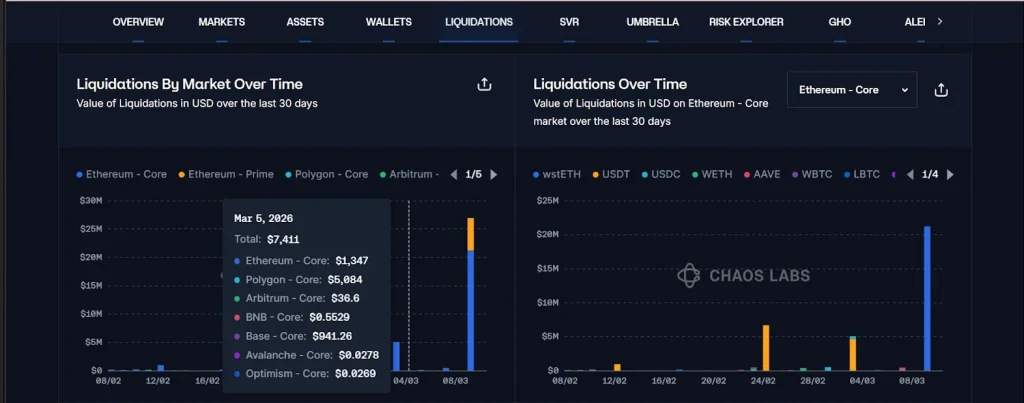
On March 10, 2026, the decentralized finance platform Aave faced an unexpected setback when a misconfigured oracle caused about $27 million in liquidations, impacting roughly 34 users. This disruption stemmed from an error in how Aave’s risk oracle, developed by Chaos Labs, misvalued the price of wstETH, Lido’s wrapped staked Ethereum token, by nearly 2.85%. As a result, the system triggered automatic liquidations on positions that were not truly at risk, exemplifying how critical reliable oracles are for the stability of DeFi protocols.
This incident highlights the vulnerability of smart contracts and the blockchain-based finance ecosystem when reliant on external data feeds. While no hack was involved, the glitch underscores that even sophisticated cryptocurrency systems can suffer losses from technical misconfigurations. Importantly, Aave has committed to fully compensating the users affected, using recovered liquidation bonuses and DAO treasury funds to make the victims whole.
Understanding Aave’s Oracle Glitch and Its Ripple Effect on DeFi Stability
Oracle technology serves as the data backbone for decentralized applications, feeding real-world prices and information to smart contracts within the blockchain. In Aave’s case, an oracle malfunction altered the market value of wstETH, one of the tokens frequently used as collateral for borrowing.
Aave employs CAPO, a risk oracle designed by Chaos Labs intended to shield the protocol against price manipulation or inflation attacks. Unfortunately, a configuration error during the processing of the wstETH/stETH price pair led to this significant undervaluation. This mispricing activated the system’s liquidation mechanisms prematurely, causing 10,938 wstETH to be forcibly sold off. Such automatic liquidations, essential for maintaining protocol solvency, became detrimental when triggered by inaccurate data.
How Oracle Glitches Test Cryptocurrency Infrastructure
This episode provides a powerful learning moment for cryptocurrency enthusiasts, especially beginners eager to understand DeFi’s complexities. Unlike hacks or network attacks, this issue was purely a technical misstep within the system’s data management layer. It serves as a reminder that smart contract security also depends on the accuracy and reliability of oracles.
Despite the loss, the Aave protocol itself remained secure, and no irrecoverable debts were recorded, highlighting the robustness of its design. Moreover, the swift response to correct the oracle settings and launch a reimbursement plan reinforces trust in the project’s governance and commitment to its community.
Aave’s Path to Recovery: Compensation and Community Assurance
Following the incident, Aave identified that liquidators profited by approximately 499 ETH due to bonus and liquidation fees. However, the protocol managed to recover 141 ETH through BuilderNet reimbursements and an additional 13 ETH from liquidation fees. This financial recovery is earmarked to fully compensate the users unfairly liquidated during the glitch.
Stani Kulechov, founder of Aave, reassured the community that the protocol’s core remained unaffected and emphasized that the problem’s root cause—the oracle misconfiguration—has been resolved. Such transparency and corrective action are vital in reinforcing user confidence in smart contract-driven ecosystems like DeFi, where trust is paramount.
The incident reiterates the essential role oracles play in DeFi and how their reliability is a cornerstone for the entire blockchain economy. For those new to the space, it also serves as an educational example of why understanding the underlying infrastructure—including oracles, smart contracts, and liquidation processes—is crucial for anyone involved in cryptocurrency.
To learn more about navigating risks and opportunities in decentralized finance platforms, exploring reliable sources about protocols like Aave is highly recommended. Also, staying updated on the latest trends and challenges through dedicated crypto news can greatly enhance your journey in the world of cryptocurrency, helping you steer clear of pitfalls like liquidation surprises.
For example, wide market liquidation events have been documented globally and can impact many assets, as explored in recent analyses on crypto liquidations. Additionally, understanding market dips and trends, such as those featuring Bitcoin volatility, can provide deeper insights into managing crypto investments safely and wisely, as detailed in expert reviews on Bitcoin price dips.