
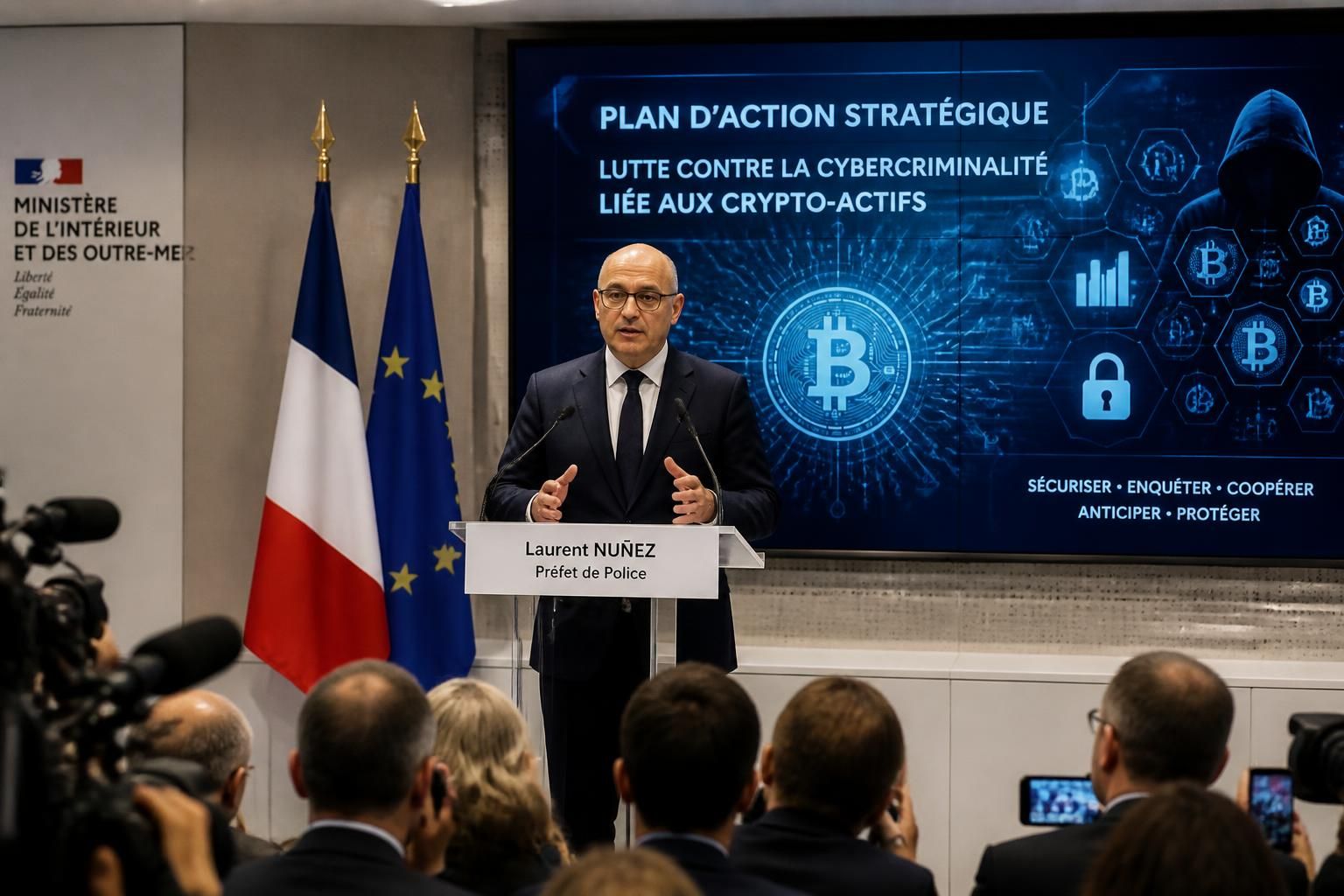
France finds itself at the epicenter of rising cryptocurrency-related crimes, with a surge in violent attacks targeting digital currency owners. Laurent Nuñez, the French Minister of the Interior, has revealed a comprehensive Strategic Action Plan aimed at Combatting this alarming increase in Cryptocurrency Crimes. The plan focuses on reinforcing law enforcement collaboration, enhancing data security, and promoting Financial Security among holders of digital assets. This new wave of offenses, marked by kidnappings, home invasions, and extortions to seize cryptocurrencies, illustrates the dark side of the booming Digital Currency ecosystem, highlighting urgent needs for Crime Prevention strategies adapted to the technological evolution of finance.
Key to this battle is coordinated work between police and gendarmerie forces and tracking down criminal networks both domestically and internationally. Efforts also address how stolen data from cyberspace breaches enable these attacks, with the rise in identity theft empowering organized crime to pinpoint targets efficiently. As the crypto environment grows, so does the complexity of Cybercrime, demanding innovative technological and regulatory responses to uphold security and trust in this revolutionary financial sphere.
Laurent Nuñez’s Strategic Action Plan: Tackling the Surge in Cryptocurrency Crimes in France
The alarming rise of violent attacks linked to cryptocurrency possession did not go unnoticed by French authorities. Laurent Nuñez described France as “an epicenter of these emerging violent crimes,” with 67 reported assaults in 2025 and already 45 more within the first few months of 2026. These crimes include kidnappings and brutal home invasions aimed at coercing victims into transferring their crypto assets under threats sometimes escalating to mutilations.
Responding to this menace, Nuñez introduced a multi-faceted plan promoting better cooperation in Law Enforcement efforts, fostering the sharing of intelligence, and targeting both the local perpetrators and the criminal networks behind them. This response involves tighter monitoring of cryptocurrency transactions and improving the cyber defenses of public and private entities, which increasingly suffer data breaches exploited by criminals. For those interested in details about such cyber vulnerabilities, the case of a teenage hacker breaching millions of accounts at a national agency became a wake-up call highlighting critical points of failure.
Rise in Crypto-Related Violence Highlights Urgent Need for Financial Security
The shift from targeting high-profile crypto entrepreneurs to threatening all cryptocurrency holders reflects the brutal reality of today’s criminal environment. Nuñez stresses the importance of raising awareness among individuals and industry representatives to adopt cautious practices, recognizing that digital currency ownership alone has made people vulnerable to physical and cyber attacks.
This strategic initiative also includes an educational drive for secure crypto asset management, encouraging users to implement practical steps minimizing their risk exposure. Meanwhile, law enforcement agencies intensify their crackdown on both high-level organizers abroad and their “small hands” operating on French soil, showcasing a comprehensive approach to disrupt the sophisticated, adaptive nature of crypto-enabled crime networks.
More on this threat and law enforcement’s response can be found through detailed reports such as those on cryptocurrency kidnappings in France, which document chilling real-life experiences and ongoing challenges facing victims and authorities alike.
Integrating Cybersecurity and Regulatory Measures for Crime Prevention
One critical front in combatting cryptocurrency crime involves addressing the surge in data breaches enabling these violent acts. Each day sees an average of three significant personal data thefts targeting both private individuals and sensitive government platforms. These breaches facilitate the identification and targeting of cryptocurrency owners, as criminals leverage stolen information to execute well-planned abductions and extortions.
The broader digital security ecosystem is caught in this evolving struggle, highlighted by controversial issues such as the European DAC8 directive, which, though intended for fiscal transparency, could inadvertently expose crypto holders to greater risks by centralizing data that might become vulnerable.
Advancements in blockchain forensics, coalescing Artificial Intelligence (AI) and machine learning, underpin the law enforcement’s ability to trace transactions and dismantle the financial channels sustaining criminal organizations. This multidimensional approach aims not only to react swiftly to incidents but to preemptively block illicit activities, safeguarding the integrity of the cryptocurrency space.
The fusion of cooperation between agencies and innovation in technology marks a turning point in the global fight against digital financial crimes. France’s pioneering Strategic Action Plan under Laurent Nuñez‘s leadership exemplifies the commitment necessary to protect citizens in the fast-changing world of Cryptocurrency.