
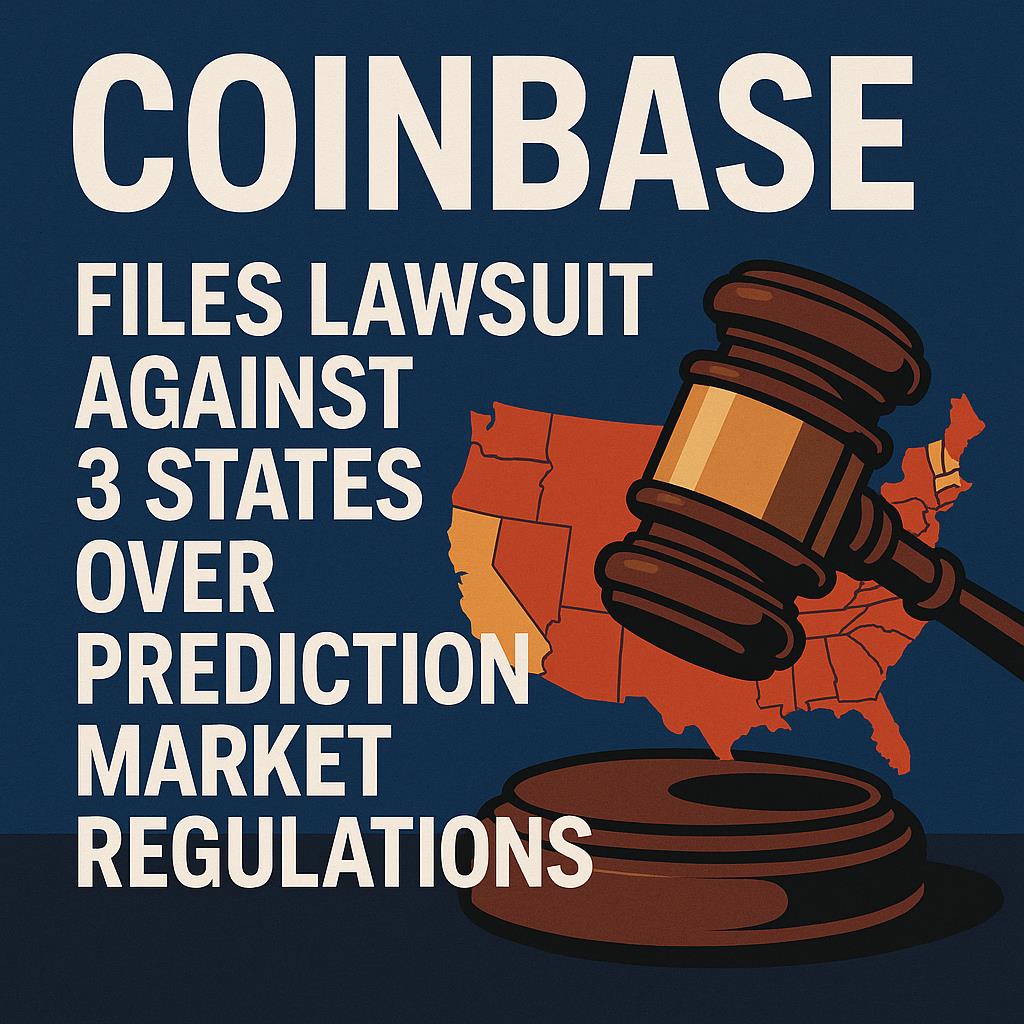
In an ambitious move to clarify regulatory boundaries, Coinbase has initiated legal battles against three U.S. states—Michigan, Connecticut, and Illinois—over their attempts to regulate its newly introduced predictive markets. This bold step underlines a critical friction point in 2025 between state-level regulations and federal oversight, with Coinbase championing the argument that these markets should be governed exclusively by the Commodity Futures Trading Commission (CFTC), not fragmented state gambling laws. As the cryptocurrency ecosystem continues to diversify beyond simple token trading into innovative financial products like predictive markets, understanding this legal clash is essential for anyone looking to navigate the evolving landscape of crypto and financial services.
In brief: Coinbase confronts regulatory challenges from three U.S. states over its predictive markets platform, asserting federal jurisdiction via the CFTC; this legal dispute highlights the tension between state regulation and emerging financial innovation in cryptocurrency; the move follows Coinbase’s partnership with Kalshi, a known player already engaging with similar regulatory issues; outcomes of these lawsuits will significantly influence how predictive markets and similar products are structured and regulated in the U.S.
Coinbase’s Legal Battle Highlights Uncertainty in Predictive Markets Regulation
One week after announcing the integration of predictive market features through a partnership with Kalshi, Coinbase squarely entered the legal arena to defend its market offering against state-level regulatory claims. Predictive markets, which allow users to bet on the outcome of events, differ notably from traditional cryptocurrencies, triggering distinct regulatory considerations. Coinbase’s Chief Legal Officer, Paul Grewal, emphasized that the attempts by Michigan, Connecticut, and Illinois to intervene disrupt innovation and contradict existing legislation by treating these markets as state-controlled gambling enterprises.
The crux of Coinbase’s argument is that predictive markets should fall exclusively under the purview of the CFTC, a federal body overseeing derivatives, rather than diverse and potentially conflicting state gaming authorities. This legal viewpoint draws a clear line in the sand, potentially setting a precedent for how new financial services built on blockchain technology will be regulated in the future.

Why the Commodity Futures Trading Commission (CFTC) Matters for Crypto Innovations
Federal oversight by the CFTC offers a more streamlined and uniform regulatory environment for financial products, which is crucial for the scalability and compliance of emerging crypto services like predictive markets. Since these markets resemble event-based derivative contracts, Coinbase argues that state-level gambling regulations are ill-suited to govern them. This distinction matters intensely as companies like Kalshi have already experienced varied responses: regulatory conflicts paused their operations in some areas like Connecticut, while in others like Nevada, compliance was enforced under local gaming laws.
For beginners about to explore cryptocurrency markets, this dispute illustrates the complexity behind offering financial services that mix betting and blockchain technology. The resolution will influence how easy or difficult it will be for innovative platforms to introduce new products without being hamstrung by a patchwork of state laws.
Impact of Coinbase’s Lawsuits on the Future of Crypto and Financial Services
The ongoing legal dispute between Coinbase and the three states is more than just a courtroom battle; it symbolizes the growing pains of a maturing crypto industry adapting to existing financial regulations. By pushing for federal recognition and unified compliance standards, Coinbase is advocating for an environment that encourages innovation while protecting users under comprehensive oversight.
This case highlights a broader trend where cryptocurrency platforms expand far beyond simple trading to include varied financial instruments, such as tokenized assets and event prediction contracts. The regulatory clarity that emerges will shape whether exchanges can offer these products seamlessly across states or face fragmented rules that limit growth.